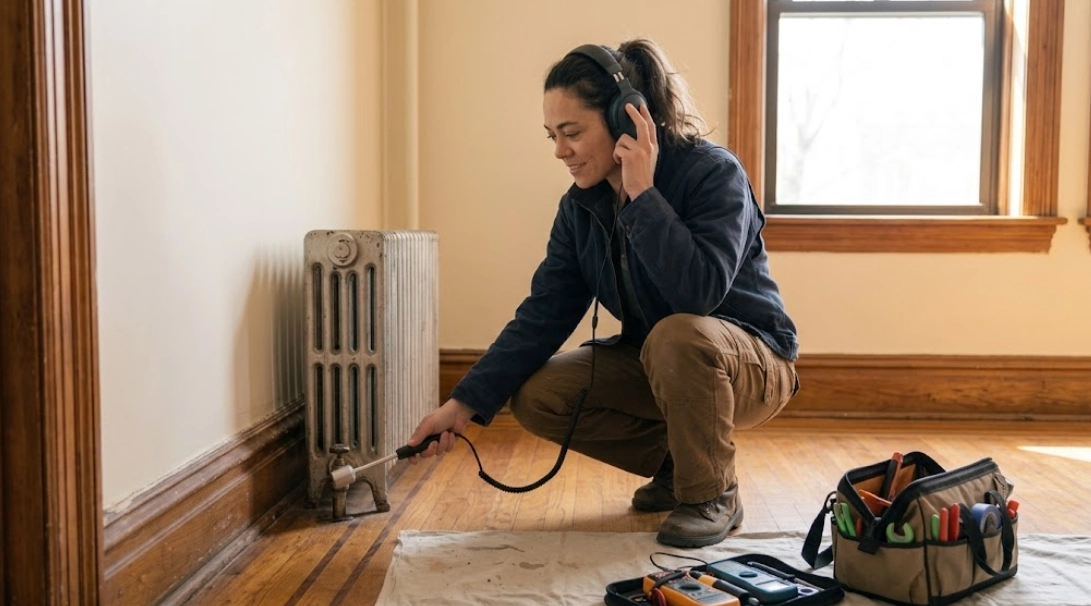
What Non-Invasive Leak Detection Involves
In high-density New York City structures, exploratory demolition to locate a pinhole water leak is costly, destructive, and often unsuccessful. Non-invasive electronic leak detection employs advanced physics to pinpoint pressurized supply line breaches through finished flooring, plastered masonry, and hollow drywalls before a single cut is made.
Specialized equipment includes electronic ground microphones that amplify the high-frequency sonic hiss of water escaping pressurized copper or PEX tubing, digital correlation sensors that calculate leak coordinates between two service points, and thermal imaging cameras that reveal minute surface temperature differentials created by warm domestic hot water seepage.
Common Indicators of Concealed Plumbing Leaks
Property owners and building managers frequently detect secondary signs of pipe degradation long before catastrophic water bursts occur. Key indicators include:
- Unexplained Water Bill Inflation: The NYC Department of Environmental Protection (DEP) Automated Meter Reading (AMR) system flags continuous 24-hour baseline consumption even when all residential fixtures remain closed.
- Subsurface Warmth & Floor Buckling: Hot water slab leaks beneath parquet, engineered hardwood, or ceramic tile cause radiant heat spots and adhesive debonding.
- Audible Acoustic Hissing: A continuous faint rushing or whistling noise near bathroom wet walls or basement service headers during silent nighttime hours.
- Dampness & Paint Efflorescence: Peeling baseboard enamel, bubbling paint, or white mineral crusts (efflorescence) emerging through brick foundation walls.
Diagnostic Considerations: Repair vs. Repiping
Distinguishing whether a leak requires a localized spot repair or a broader capital repiping program depends on pipe material age, water chemistry, and systemic corrosion patterns:
| Condition | Diagnostic Finding | Recommended Scope |
|---|---|---|
| Isolated Mechanical Puncture | Drywall screw or picture anchor pierced supply pipe | Localized spot repair; solder coupling or pro-press sleeve |
| Pinhole Pitting in Galvanized Steel | Internal mineral buildup with multiple micro-fissures | Riser replacement; complete copper or PEX repiping |
| Under-Slab Hot Water Line Degradation | Soil erosion under foundation with thermal signature | Overhead pipe bypass rerouting; abandon defective under-slab line |
Essential Safety & Structural Precautions
Water leaks in multi-story apartment buildings carry severe structural and electrical hazards. If water is dripping near electrical junction boxes, circuit breaker panels, or ceiling lighting fixtures, power to the affected zone must be isolated immediately at the main distribution panel before approaching the area. Prolonged moisture saturation in pre-war plaster-and-lath ceilings creates sudden collapse risks.
Questions Property Owners Should Ask Before Testing
- Are your technicians using digital acoustic correlators and thermal cameras rather than tearing open walls for exploratory searches?
- Can you provide a documented static pressure decay test on both hot and cold domestic branches?
- Will the inspection report include photographic thermal imaging evidence acceptable to insurance claims adjusters?
Verified Network Destinations for Leak Detection
Explore localized leak detection resources across our dedicated New York network subdomains: